
Explore Future Trends in Thermal Energy Networks for 2026

Thermal Energy Networks 2026: Trends, Technologies, and Practical Guidance
Thermal energy networks (the systems that move heat and cooling across buildings and districts) are evolving rapidly. Improved geothermal integration, denser thermal storage options, and smarter distribution controls are reshaping how owners and contractors plan, operate, and finance these systems. This article lays out what the 2026 landscape looks like, why the newest technologies matter for decarbonization and cost control, and how project teams can evaluate and act on these shifts. You’ll get the highest-impact trends to watch, the key advances in geothermal and storage, and practical steps businesses can take to capture operational and commercial value. We link district design changes to component-level considerations like heat exchangers, piping, and valves, and map storage choices to real-world use cases and trade-offs, finishing with where to get help for feasibility and implementation.
For deeper analysis and practical guides, visit ProProfitBuild resources.
What are the key trends shaping thermal energy networks in 2026?
In 2026, successful thermal networks combine renewable thermal inputs, modular hybrid architectures, and storage that enables load shifting and resilience. Advances in drilling, materials, and control systems are lowering upfront costs, while storage and smarter controls increase dispatchability and predictable operating costs. Together, these trends create a more affordable pathway to decarbonize districts, campuses, and industrial zones through coordinated design and tariff-aware metering. Below are the most consequential trends practitioners should monitor.
Key trends to watch in 2026:
- Faster integration of geothermal and storage into district networks, driving lower lifecycle costs and steadier thermal supply.
- Modular, hybrid system designs allow phased deployment and flexible capacity scaling.
- Shift to lower-temperature distribution, which cuts losses and opens the network to heat pumps and waste-heat reuse.
- Wider adoption of thermal energy storage, which smooths peak demand and reduces reliance on fossil peaker plants.
- Advanced controls and digital twins improve hydraulic balance and enable predictive maintenance.
Increasingly, these complex systems are optimized with digital tools and real‑time models.
Digital twin optimization for CCHP-CER systems
Researchers demonstrate a digital twin framework that updates operating parameters in real time, using current performance and short-term forecasts to find near‑optimal setpoints. This approach improves lifecycle operation by adapting controls to actual and predicted conditions.
Those shifts create new readiness needs for planning and procurement, which brings us to how district heating and cooling are adapting to modern energy demands.
When organizations assess readiness, ProProfitBuild helps owners and developers prioritize feasibility studies and shape roadmaps. Our advisory work aligns technical choices with commercial milestones so teams can turn high‑level trends into fundable project phases.
How is district heating and cooling evolving for modern energy demands?
District systems are moving to lower-temperature distribution, modular substations, and customer-side upgrades that accept heat pumps and other renewables. Lower temperatures reduce distribution losses and make shallow geothermal and solar thermal easier to integrate, provided distribution piping and materials are updated and insulated. Operators combine building retrofits and smarter thermostatic interfaces with network-level controls to smooth demand and enable tariff signaling. These changes alter component roles (heat exchangers, pumps, valves) and require updated commissioning and hydraulic balancing to ensure system reliability.
Networks increasingly expand in stages using standardized modules so new connections and capacity increases are easier to design and finance. Standardization cuts engineering time, lowers installation risk, and enables repeatable procurement of thermal storage modules and substations, creating straightforward entry points for next‑generation geothermal in district architectures.
What role do renewable thermal solutions play for businesses?
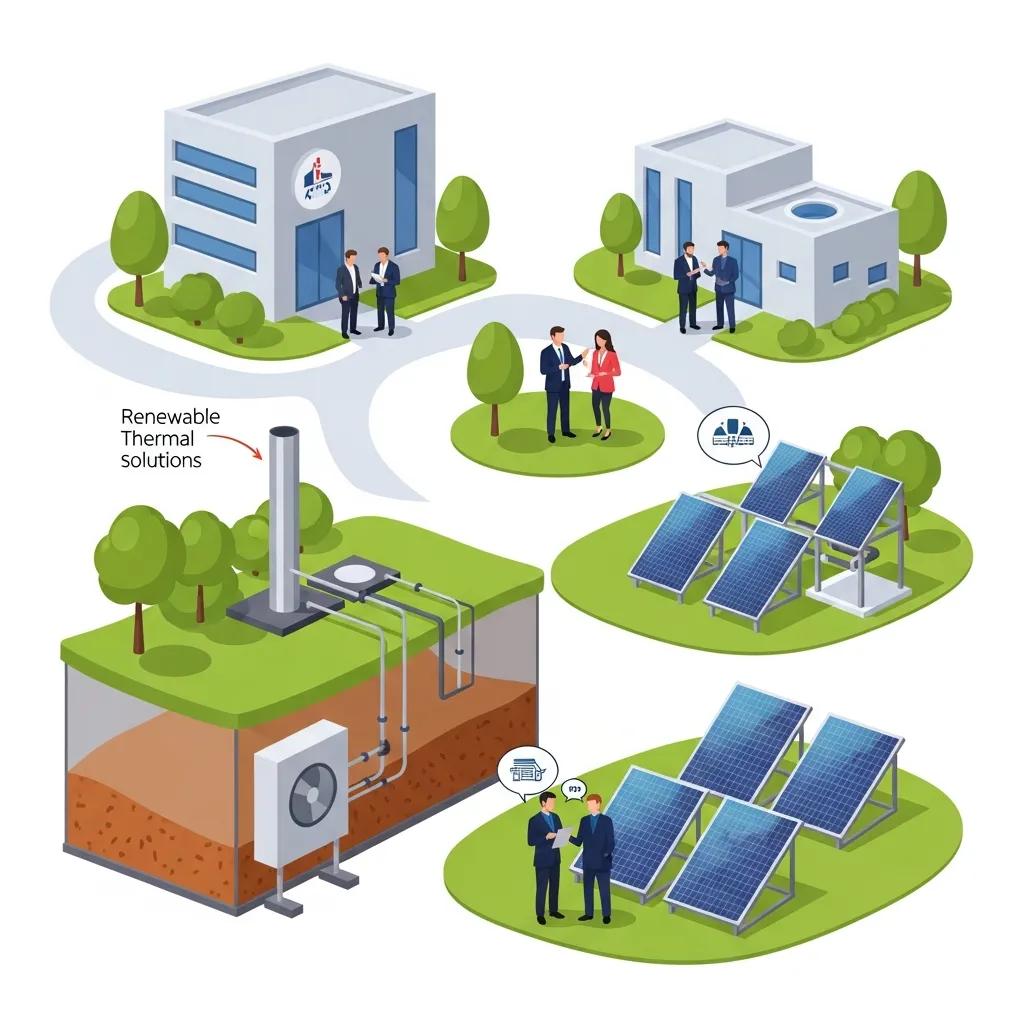
Renewable thermal options (geothermal heat pumps, solar thermal, and recovered waste heat) cut operating costs, lower carbon intensity, and boost resilience for businesses that deploy them. Replacing or reducing fossil boilers and onsite gas peakers stabilizes energy spend, eases regulatory compliance, and supports corporate sustainability goals. Practically, that shows up as fewer onsite emissions, more predictable thermal pricing, and reduced exposure to fuel volatility, outcomes that appeal to campus owners, manufacturers, and large facilities teams. Clear commercial benefits help owners time investments to maintenance cycles and capital planning.
Businesses that adopt renewable thermal systems can also monetize surplus heat, join local heat-tariff programs, or participate in demand-response schemes, all of which improve project returns and help scale a broader thermal strategy.
How are next-generation geothermal systems transforming thermal energy networks?
Next-generation geothermal lowers installation cost, expands siting options, and integrates more smoothly with district architectures. Better drilling methods, modular field layouts, and improved ground-exchange materials increase thermal yield per footprint and shorten delivery timelines. As a result, geothermal is shifting from deep, bespoke projects to hybrid shallow-deep configurations that can serve distributed loads across campuses and districts. Those characteristics make geothermal a credible, dispatchable thermal source that pairs well with storage and heat pumps for steady low‑carbon supply.
Hybridizing geothermal with other renewables and storage is proving especially effective at improving dispatchability and operational performance.
Geothermal–solar hybridization with thermal storage
A case study shows how integrating a solar thermal topping cycle and direct thermal energy storage can improve dispatchability at an underperforming geothermal site. The hybrid approach smooths output and increases usable thermal energy during peak periods.
Because geothermal can now be delivered in modular arrays and tied to network headers, careful system selection and integration planning are critical to match field capacity with seasonal storage and peak-shaving needs. Teams typically need technical‑commercial guidance to choose between shallow arrays and deeper bores, a natural place for an advisory conversation.
For teams evaluating geothermal fit, ProProfitBuild provides consultative guidance on integration options and system-selection trade-offs and invites interested owners to book a free strategy session focused on ROI estimates and implementation sequencing.
What innovations define advanced geothermal technologies?
Key innovations include modular field designs, higher‑conductivity grouts and heat‑exchange materials, and faster, more efficient drilling techniques that reduce the per‑kW installed cost. Modular geothermal arrays use standardized boreholes or horizontal-loop units that can be added incrementally, enabling staged capital deployment and predictable output. New grout and heat-exchange materials improve thermal transfer to ground‑source heat pumps, raising COP and shrinking footprint needs. These advances shorten onsite work and simplify civil scope, making geothermal practical for urban retrofits and constrained sites.
Modularity plus material improvements yield predictable performance that pairs naturally with seasonal thermal storage, enabling higher renewable-thermal penetration across districts. That context leads to how geothermal connects hydraulically and through controls with district heating and cooling.
How do geothermal systems integrate with district heating and cooling?
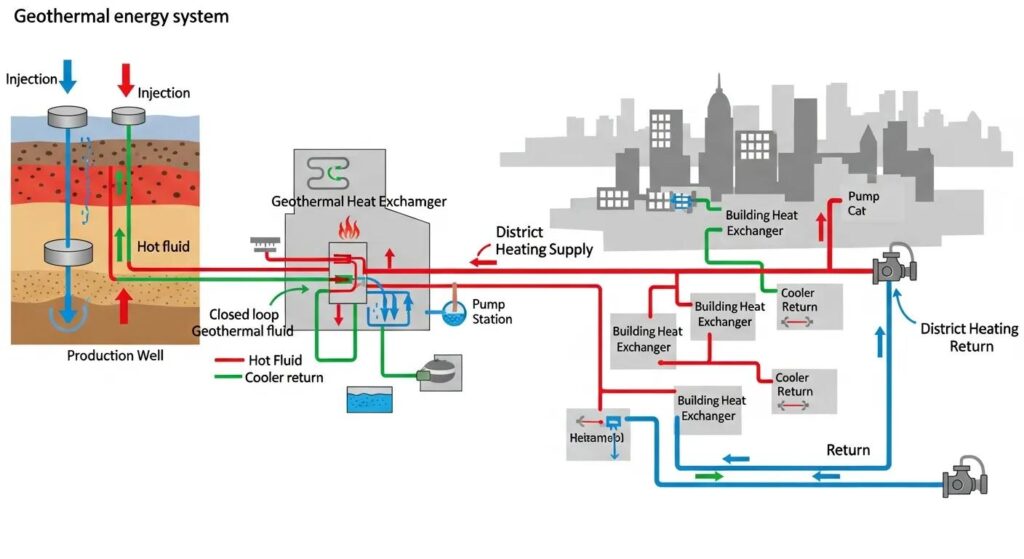
Geothermal typically appears in hybrid configurations where it supplies base or mid-load heat while boilers, heat pumps, or thermal storage handle peaking and seasonal swings. Integration requires careful hydraulic balancing, heat‑exchanger sizing for temperature matching, and control strategies that coordinate setpoints and pump staging. Geothermal fields usually connect via substations with dedicated exchangers and metering to ensure tariff compatibility and transparent billing. Siting choices consider land availability, ground conditions, and proximity to distribution headers to minimize piping and pumping losses.
Control logic often prioritizes low‑carbon sources and schedules storage cycling to absorb surplus geothermal output; this coordinated strategy maximizes fuel displacement and lowers operating costs. Those integration patterns point directly to the storage innovations that make hybrid deployments both resilient and economical.
What are the latest innovations in thermal energy storage for 2026?
In 2026, storage advances focus on higher energy density, modular tanks, and approaches that reduce footprint or standing losses while enabling faster discharge. Sensible storage, latent (PCM), and thermochemical solutions each serve clear roles based on capacity, response time, and site limits. Sensible tanks remain cost‑effective for large seasonal stores; PCMs fit space‑constrained locations; and thermochemical systems offer long‑duration storage with low standing losses. Together, these options support peak shaving, load shifting, and resilience strategies that help networks absorb variable renewable thermal supply.
Emerging research highlights thermochemical methods as promising for minimizing storage volume and heat loss in building applications.
Thermochemical energy storage for buildings
A state‑of‑the‑art review summarizes thermochemical storage technologies for buildings, noting that, compared with sensible and latent approaches, thermochemical materials can reduce storage volume and standing losses for long‑duration applications.
Below is a concise comparison of main storage categories to help planners select the right approach for a given network.
Introduction: The table compares core storage approaches by capacity, discharge behavior, footprint, and common best uses.
| Storage Type | Attribute | Typical Value / Best Use |
|---|---|---|
| Sensible (water tanks) | Capacity and cost | High capacity, low cost per kWh — suited for seasonal or bulk storage |
| Latent (PCM) | Energy density and footprint | High energy density and compact footprint — ideal for space‑limited sites |
| Thermochemical | Duration and loss profile | Long‑duration storage with low standing losses — best for extended seasonal shifting |
This comparison shows sensible tanks for bulk shifting, PCMs for footprint‑limited use, and thermochemical systems for multi‑week storage with low losses.
Which thermal storage technologies improve efficiency and reliability?
Sensible tanks, phase‑change materials, and thermochemical options all raise network efficiency when matched to operational patterns and renewable supply. Sensible tanks are proven and simple, providing bulk capacity for large campuses and districts. PCMs offer high density where space is limited or at substations where footprint matters. Thermochemical storage emerges for long‑duration needs, decoupling duration from tank size and improving resilience where seasonal variability is significant.
Choosing the right storage means matching discharge rate, cycle frequency, and lifecycle cost to network objectives and renewable profiles.
How do storage solutions support renewable thermal adoption?
Storage increases the usable share of renewable thermal by absorbing variable production, shifting it to meet demand, and reducing the need for fossil peakers. By enabling load shifting and peak shaving, storage smooths geothermal and solar thermal dispatch and creates reliable windows for maintenance. For businesses, that translates into lower reliance on fuel-based peaking plants, reduced emissions, and better alignment with regulatory or contractual decarbonization targets. Storage also provides on‑site thermal reserve for resilience during outages.
Operationally, storage lets operators schedule geothermal and solar output around tariff periods and optimize heat‑pump staging so renewable thermal contributes reliably to daily heating and cooling needs.
How can businesses benefit from renewable thermal solutions in the future?
Organizations that deploy renewable thermal systems realize operational savings, stronger emissions reporting, and new revenue or project opportunities through network participation. These systems reduce fuel use and exposure to volatile gas markets while supporting sustainability reporting and stakeholder commitments. For many asset owners, replacing fuel‑intensive systems improves asset value through lower operating costs and the ability to market low‑carbon buildings to tenants and customers. Mapping services to outcomes helps decision‑makers select the right path from assessment to implementation.
Below is a succinct mapping of advisory services to business outcomes, showing how phased engagements reduce technical and commercial risk.
Intro: The table maps common advisory services to the business benefits they deliver, aiding procurement and budgeting decisions.
| Service Offering | Attribute | Business Benefit |
|---|---|---|
| Feasibility Study | Technical‑commercial analysis | Short‑term capex/opex outlook and payback estimate |
| Design & Engineering | System specification and procurement | Lower implementation risk and predictable schedules |
| Project Advisory / Consulting | Implementation sequencing and ROI planning | Reduced operational risk and improved funding readiness |
These mappings show how staged advisory work turns technical options into measurable business outcomes.
To learn more about the team driving these solutions, see the ProProfitBuild leadership team and our commitment to sustainable energy strategies.
What are the advantages of adopting renewable thermal energy?
Renewable thermal systems deliver measurable benefits: lower operational emissions, more stable energy costs, better regulatory alignment, and greater resilience to supply disruptions. Lower emissions support corporate sustainability targets and can reduce exposure to compliance costs or carbon pricing. Stable thermal costs come from replacing volatile fuel contracts with predictable operational models backed by geothermal and storage. Resilience follows from onsite thermal reserves and diversified supply, protecting operations during fuel or grid interruptions.
These advantages make renewable thermal attractive for campuses, manufacturers, and service providers seeking long‑term contracts and predictable energy budgets.
Which industries are leading in renewable thermal integration?
Urban districts, higher‑education and healthcare campuses, and industrial process heat users lead renewable thermal adoption because they have concentrated thermal loads and long asset horizons. Urban and mixed‑use developments gain economies of scale from shared distribution infrastructure. Campuses (universities, hospitals) prioritize year‑round reliability and sustainability. Industrial sites with steady process heat see direct financial returns when replacing fossil heat with geothermal and storage solutions due to high fuel use and long operating hours.
These patterns show where contractors and developers can expect consistent demand for integrated geothermal and storage projects and where targeted advisory support is most useful.
When you’re ready to evaluate or adopt renewable thermal solutions, ProProfitBuild offers coaching and lead‑generation support. We invite decision‑makers to book a free strategy session focused on ROI modeling and implementation planning to move from concept to funded projects without getting bogged down in technical detail.
- Assess readiness: Begin with a feasibility study to confirm fit and payback.
- Design strategically: Use modular, hybrid designs to control capex and phase deployment.
- Plan implementation: Sequence geothermal, storage, and customer retrofits to limit disruption.
These steps form a practical roadmap for capturing the operational and commercial benefits outlined above.