
The way buildings exchange energy is undergoing a fundamental shift. 5th generation district energy is at the center of that shift, representing a departure from centralized heat and power production toward something far more dynamic, efficient, and responsive to how modern buildings actually behave. For developers, building owners, and city planners, understanding what this technology does and why it matters is becoming a core competency rather than a niche concern.
What Is 5th Generation District Energy?
District energy systems have evolved through distinct generations over the past century. Early systems delivered high-temperature steam from central plants. Later generations lowered supply temperatures and improved insulation. Each generation brought incremental gains in efficiency and flexibility.
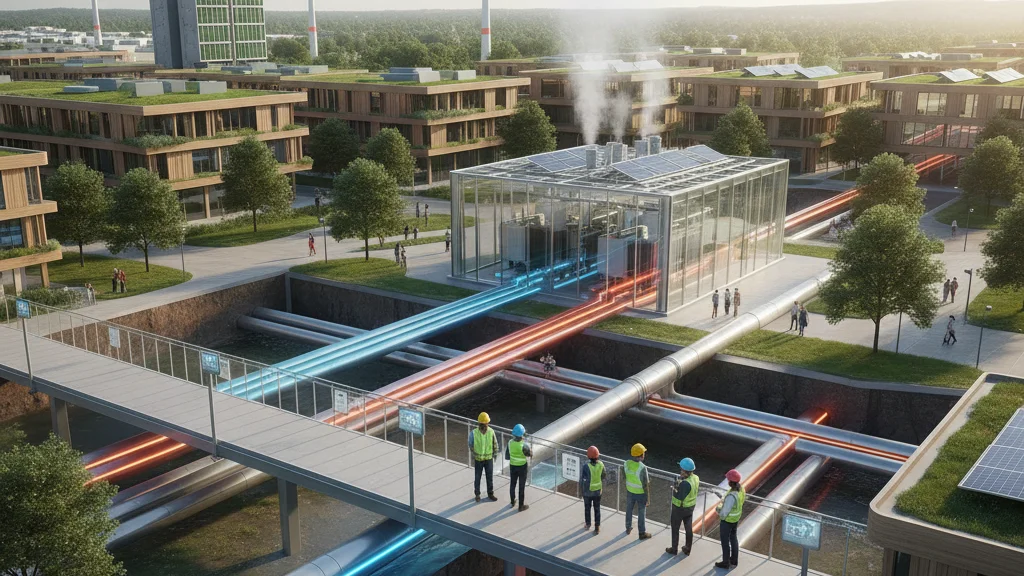
Fifth generation district heating and cooling, often abbreviated as 5GDHC, breaks from that linear progression in a meaningful way. Rather than distributing heat or cold from a single central source, 5GDHC systems operate at near-ambient ground temperatures, typically between 10 and 25 degrees Celsius depending on the local climate and geology. Buildings connected to the network do not passively receive energy from a central plant. Instead, they interact with a shared thermal loop, extracting heat in winter and rejecting heat in summer, all through decentralized heat pump units located within each building.
The result is a bidirectional network where energy flows in both directions depending on demand. A building that needs cooling in the afternoon can effectively export rejected heat into the loop, which another building on the same network uses for space heating at the same time. This simultaneous exchange of thermal energy between buildings is the defining characteristic that separates 5GDHC from all previous district energy generations.
The Core Technology
The backbone of a 5GDHC system is a closed-loop pipe network filled with water or a water-glycol mixture circulating at ground temperature. This loop connects to each building through a heat pump that either extracts heat from the loop or dumps heat into it based on whether the building needs heating or cooling.
Because the loop operates at near-ambient temperatures, distribution losses are dramatically lower than in conventional district heating. A hot-water distribution network at 80 or 90 degrees Celsius loses significant energy to the surrounding soil, especially over long distances. A loop running at 15 degrees Celsius loses almost nothing, because the temperature difference between the pipe contents and the surrounding ground is minimal.
The heat pumps within each building do the heavy lifting of temperature elevation or reduction. Because modern heat pumps can achieve coefficient of performance values well above 3, the electrical input required per unit of thermal output is a fraction of what resistive electric heating or direct-expansion cooling would consume.
Some 5GDHC installations incorporate geothermal boreholes or aquifer thermal energy storage to stabilize the loop temperature across seasons. By storing heat captured in summer and cold captured in winter, these systems reduce the variation that individual heat pumps must compensate for, improving overall system efficiency year-round.
Why Buildings Are a Different Proposition With 5GDHC
Conventional district heating connects buildings as consumers of a centrally produced product. The economics and control architecture reflect that model. A central plant operator produces heat and sells it. Buildings buy it. The relationship is one-directional.
With 5GDHC systems, every connected building is both a potential consumer and contributor of thermal energy. This changes the economic logic considerably. Buildings with high internal heat gains, such as data centers, commercial kitchens, or server rooms, can become net thermal contributors to the loop rather than pure consumers. That contribution has value to the network and to neighboring buildings drawing from it.
For mixed-use developments combining residential, retail, office, and hospitality uses, this means the diversity of thermal loads across different building types can be leveraged systematically. The aggregated effect is a reduction in peak demand that would otherwise require larger, more expensive central plant equipment in conventional heating and cooling approaches.
Buildings in a 5GDHC network also retain individual control over their indoor environments. Each building's heat pump operates independently based on its own occupancy, scheduling, and setpoints. There is no dependency on a central dispatch signal for moment-to-moment temperature management. This architectural feature simplifies controls integration and reduces single points of failure across the network.
Compatibility With Existing Building Stock
One practical question for any energy technology involves retrofit viability. Not every building owner is working with a blank slate. Fifth generation district heating integration with existing buildings is feasible in many cases, though it requires careful assessment.
Buildings with hydronic systems, meaning those already using water-based heating and cooling distribution through fan coils or radiant panels, adapt most naturally to 5GDHC. The heat pump replaces the existing boiler or chiller, connecting to the district loop on one side and the building's internal hydronic distribution on the other.
Buildings using forced-air systems face a more involved retrofit because heat pumps connected to 5GDHC loops typically perform best with the lower supply temperatures suited to hydronic distribution. Adapting air-handling equipment to work efficiently with those supply temperatures adds complexity, though solutions exist for motivated project teams.
New construction projects have the cleanest path to 5GDHC integration because the building systems can be designed from the outset around the loop's operating parameters. Developers designing multi-building campuses, mixed-use districts, or large residential communities are increasingly evaluating 5GDHC from early planning stages to take full advantage of the technology's benefits.
Grid Interaction and Renewable Integration
5GDHC systems align naturally with the direction electricity grids are moving. As renewable generation from wind and solar becomes a larger share of grid supply, the temporal mismatch between generation peaks and demand peaks grows. Grids benefit from flexible loads that can absorb electricity during high-generation, low-demand periods and reduce consumption when the grid is stressed.
Heat pumps in a 5GDHC network are well positioned to serve as that flexible load. Thermal storage integrated into buildings or within dedicated network storage vessels allows heat pumps to pre-condition thermal mass when electricity is abundant, shifting demand away from peak grid periods. Building owners can benefit economically from time-of-use electricity tariffs while contributing to broader grid stability.
This interaction between 5GDHC and the electrical grid is a significant consideration for utilities, grid operators, and municipalities looking at how district-scale thermal infrastructure can support decarbonization goals without requiring expensive grid reinforcement.
Planning and Implementation Considerations
Implementing a 5GDHC network involves coordination across disciplines that do not often work closely together: civil engineers designing the pipe network, mechanical engineers specifying building-level heat pump systems, geologists assessing ground conditions for geothermal elements, and urban planners considering right-of-way and phasing.
Network sizing depends on the thermal diversity of the connected buildings. Greater diversity of use types and operating schedules translates to higher simultaneous load sharing and smaller required pipe diameters. A network connecting only office buildings with similar occupancy patterns captures less diversity benefit than one connecting a hotel, residential towers, a grocery store, and a fitness facility.
Phasing is also a strategic consideration. Networks can be built with initial anchor connections and expanded over time as additional buildings join. Getting the pipe sizing and ground work right in the initial phase avoids costly retrofits later.
Putting It Into Practice
For building owners, developers, and communities evaluating their energy future, fifth generation district heating and cooling represents a technically mature and commercially viable path toward lower operating costs, reduced carbon emissions, and resilience against energy price volatility. The technology is no longer experimental. It is being deployed across Europe and in a growing number of North American projects, with each installation generating performance data that continues to validate the underlying approach.
Understanding the fundamentals is a starting point. Translating that understanding into a viable project requires site-specific analysis, load profiling, ground condition assessment, and network design work that accounts for the unique characteristics of each location and building portfolio.
ProProfitBuild works with energy and construction projects where these questions are central to long-term asset performance. If your next project involves district-scale energy infrastructure or building-level thermal system design, connecting with a team that understands the full stack from ground conditions to building controls is a worthwhile early step.